

Hydropower production planning has quietly become one of the harder jobs in the energy sector. You pull last night's inflow report, cross-reference it against a market forecast open in another tab, update the dispatch spreadsheet, check environmental constraints from a separate document, and try to build a plan that holds, usually before the morning meeting, usually working with data that's already a few hours old by the time the plan is done.
That works, until the river does something unexpected. A storm system moves faster than forecast. Snowmelt accelerates two weeks ahead of the model. A price window opens at 14:00 that wasn't there when you filed the morning plan. Each of those events means starting over, or deciding it's not worth it and living with a plan you know isn't optimal.
Digital planning software changes the inputs to your job, not the job itself. The judgment calls are still yours. But instead of spending the morning reconciling four data sources before you can even start thinking about today’s plan, you start with a plan and spend your time stress-testing it.
Why Do Hydropower Plants Struggle With Manual Production Planning Software?
There was a window — maybe ten years long — where a careful planner with a good spreadsheet could do most of this well. Inflows were more predictable. Day-ahead markets moved at human speed. Compliance was an annual report, not a continuous obligation.
That window has closed. A planner today is balancing:
• Inflows that climate change is making more variable, not less
• Spot prices that move meaningfully inside a single shift
• Machine efficiency curves across a fleet that may include Run-of-River, storage, and Pump-Storage units in the same cascade
• Minimum-flow requirements, ramping limits, and reporting deadlines you can’t miss
• Cascade dependencies, where what you do at the top reservoir at 09:00 constrains what’s possible downstream by the afternoon
Manual tools weren’t built for this. The problems show up as small daily frictions before they show up as missed generation. Data lives in different places. Updates lag. The plan you’re working from at 14:00 was built on the 06:00 forecast, and the river already disagrees. By the time you’ve reconciled everything for the next day’s nomination, three things have changed again.
You don’t lose generation in one big mistake. You lose it in dozens of small ones — a turbine running off its efficiency point for an hour, a spill that didn’t have to happen, a price window that closed before you could replan.
What Is Integrated Water Management Software and How Does It Work?
Integrated water management software is crucial for hydropower plants because it eliminates the data fragmentation that makes manual planning slow and error-prone. When inflow forecasts, market signals, and compliance constraints are connected in a single planning engine, you can make better decisions faster, without spending the first half of your shift reconciling conflicting inputs.
The practical meaning is this: your forecasting data, your market data, and your compliance constraints all need to feed into the same planning engine at the same time.
When they don't, you get the familiar problem of optimizing one thing while inadvertently undermining another. Push for maximum generation during a price spike and you risk breaching a minimum downstream flow requirement. Follow the conservative inflow forecast and you leave a trading window on the table. A good integrated hydropower operations platform holds all of those constraints simultaneously, the optimization runs across them, not around them.
Here's how that plays out across the three main data streams:
Inflow Forecasting
If you don't have a reliable read on what water is coming into your reservoir, the rest of the plan is built on assumption. That's fine when inflows are predictable — it's costly when they're not.
Modern platforms integrate real-time weather data directly into hydrological models, so inflow predictions stay reliable even as conditions shift. When a storm system accelerates or snowmelt picks up unexpectedly, the forecast updates accordingly — and because the models handle that complexity automatically, the risk of human error in the translation from weather signal to water volume drops significantly.
That shared, continuously updated picture also extends your planning horizon. With model-driven forecasts feeding a centralised platform, you and your colleagues are working from the same data at the same time — no reconciling versions, no lag between what the hydrology team sees and what production planning is working with. That's what makes it possible to plan confidently up to 12 months ahead, rather than rebuilding from scratch every morning.
Market Signals
Energy markets don’t reward planners working on a 24-hour cycle. Day-ahead, intraday, and ancillary services all move on tighter clocks than a manual workflow can match.
When market data feeds the same engine your forecast does, replanning is a question of minutes, not hours. With HYDROGRID Insight, a full dispatch plan recalculates in under two minutes, which sounds like a technical detail until you’ve actually had a price spike at 14:00 and needed an answer before 14:30.
Compliance and Constraints
The cost of a compliance failure isn't symmetric. A missed minimum flow requirement or a late environmental report isn't just paperwork; it carries reputational risk and can affect your operating licence.
When compliance constraints are embedded directly into the planning model rather than checked after the fact, you stop treating regulations as a post-optimization filter. The system won't surface a plan that violates a downstream flow constraint; it finds the best plan within those constraints. The compliance check and the optimization happen at the same time.
Manual Planning vs. Digital Planning: A Direct Comparison
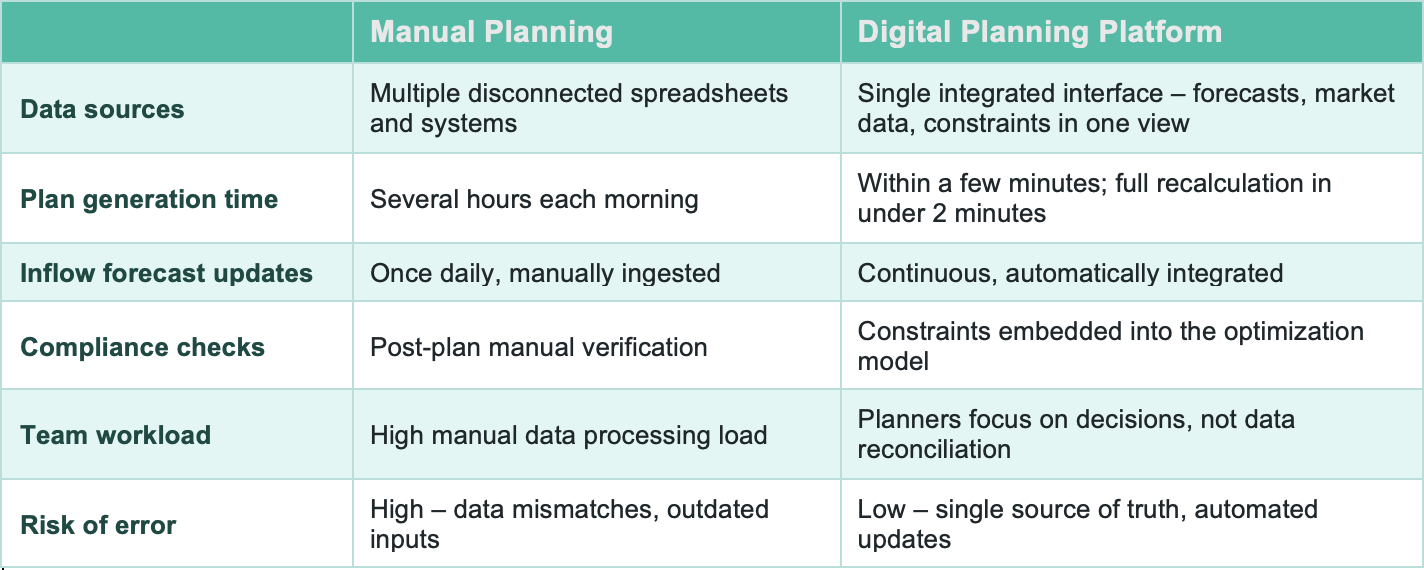
The difference isn't just time saved. It's the quality of the decision itself, because it's based on more up-to-date, more complete information.
How Much Manual Effort Does Digital Planning Actually Save?
HYDROGRID customers regularly report saving up to 95% of the manual effort that previously went into production planning. That sounds like a big claim, so it's worth unpacking what it means in practice.
It doesn't mean eliminating your planning team. It means redirecting what they do.
The hours your team currently spends pulling data from different systems, reconciling discrepancies, running and re-running calculations, and formatting reports -> that's the 95%. When a platform automates data ingestion, model updating, and scenario generation, your planners shift from being data processors to being decision-makers.
That matters for two reasons. First, better decisions get made because your team has time to actually think about them. Second, the job becomes more sustainable. Nights and weekends spent recalculating plans because conditions changed become rare exceptions rather than normal practice.
How Better Production Planning Increases Generation Value?
How your plant sells power — spot market, PPA, regulated tariff — changes the trading conversation. It doesn’t change the planning conversation. The levers are the same:
• More generation from the same water. Running turbines on their efficiency curves instead of off them. Avoiding spill that wasn’t necessary.
• Better water use. In PPA and regulated environments especially, every cubic metre matters more than the price per MWh.
• Maintenance scheduled honestly. Pulling a unit during a low-inflow window costs less than pulling it during peak generation. Better forecasts make that call easier to make confidently.
• Compliance you don’t have to think about. Staying inside the constraints protects the operating license, which sits underneath everything else.
Across operators we work with — in liberalized markets and regulated ones — generation increases of up to 12% from machine efficiency and water management alone are realistic, before any market optimization is layered on top. The reason it compounds is that small improvements happen across thousands of dispatch decisions a year. Manual planning can’t capture that volume of small wins; the math doesn’t work.
How Long Does It Take to Implement Hydropower Planning Software?
The hesitation we hear most often is some version of: our setup is specific, this won’t fit how we work.
It’s a fair instinct. Hydropower operations vary significantly - cascade configurations, mixed fleet types (Run-of-River, Pump-Storage, reservoir storage), and regulatory environments that differ by market and licence condition. A platform that doesn't account for that specificity isn't much of an upgrade from the spreadsheet.
What’s changed is the implementation itself. A modern SaaS platform connects to the data sources you already have and goes live in weeks. Onboarding a new planner is hours of training, not a quarter of shadowing. The operational lift is smaller than most teams expect going in.
The Practical Takeaway
Production planning sits upstream of everything else in hydropower operations. The quality of the plan determines how efficiently you use the water, how well you align with market conditions, and whether your environmental commitments hold. A poor plan compounds its cost across every dispatch cycle.
What digital planning tools actually do is give you better information at the moment the decision needs to be made; a model that reflects current conditions and flags when the plan needs to change, rather than a static snapshot dressed up with today's date.
If your current planning cycle relies on you holding all of that together manually, it's worth examining what that's costing you across a full year of dispatch decisions.
Frequently Asked Questions
What is hydropower plant digital planning software? Hydropower plant digital planning software is a platform that integrates inflow forecasting, energy market data, and regulatory constraints into a single planning engine. It automates scenario generation and plan updates, replacing the manual process of reconciling data across spreadsheets and separate systems.
How does digital planning software improve hydropower generation? By continuously updating inflow forecasts and optimizing machine dispatch schedules, digital planning software ensures operators make decisions based on current conditions rather than outdated inputs. HYDROGRID customers have seen generation increases of up to 12% through improved machine efficiency and water management.
What are the main manual planning challenges in hydropower? Manual planning typically suffers from siloed data, slow update cycles, and high cognitive load on planning teams. Decisions are often based on stale inputs, mid-day replanning is difficult, and compliance checks happen after; rather than during the optimization process.
What does integrated water management mean in hydropower? Integrated water management in hydropower means connecting inflow forecasts, market signals, and compliance constraints into a single, unified planning model. When these data streams are integrated, operators can optimize generation without inadvertently violating environmental rules or missing market opportunities.
How long does hydropower planning software take to implement? Most modern hydropower operations platforms are designed for rapid deployment, typically within weeks, not months. Team training usually takes hours rather than days, and the platforms are built to connect to existing data infrastructure rather than replace it.
Does hydropower digital planning software work for regulated markets and PPAs? Yes. While market optimization features are valuable for plants trading in liberalized markets, the core planning benefits - improved inflow forecasting, machine efficiency optimization, and water use efficiency, apply regardless of how power is sold. Plants operating under PPAs or regulated tariffs typically see the same generation improvements as those in competitive markets.

